
Noillirk

Noillirk
Noillirk Daily: A Five-Minute Cap and a 2,500-Point Ceiling
Noillirk asks ten prompts a day and allows thirty seconds for each, which puts a hard five-minute ceiling on the answering before a single reveal is counted. You type the answer most people would give, submit it, and the climb moves: the more of the crowd's hundred that agree with you, the higher the figure in the corner. The score ceiling is 2,500 points, and the game maps a perfect Daily to 14.0 km.
Put those two numbers side by side and the Daily stops looking like a quiz and starts looking like a route with a time budget. Ten typed answers, ten submissions, and one decision that repeats ten times: whether to watch the result card or tap past it. That last choice is the only place in a run where seconds are actually yours to save, because the other thirty belong to the prompt.
Noillirk in Three Frames: 8,450 m, the Top 5, 9,708 m
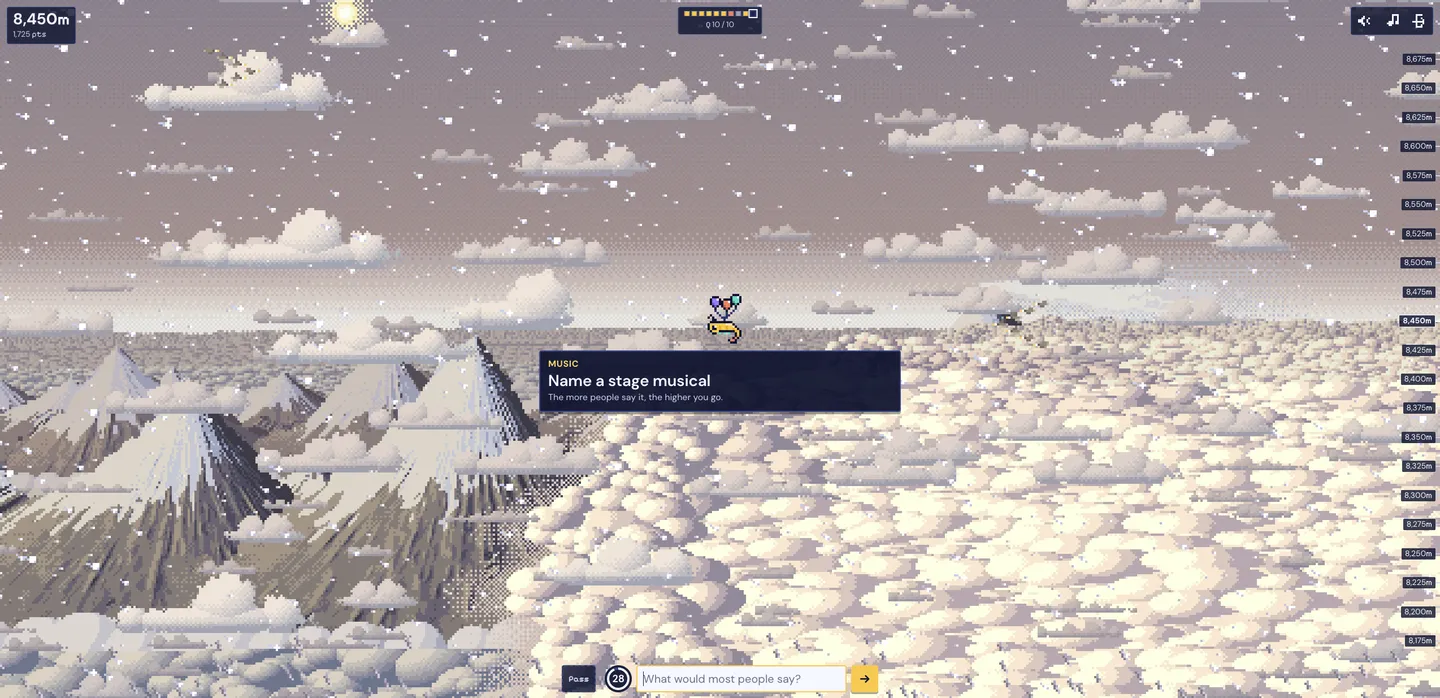
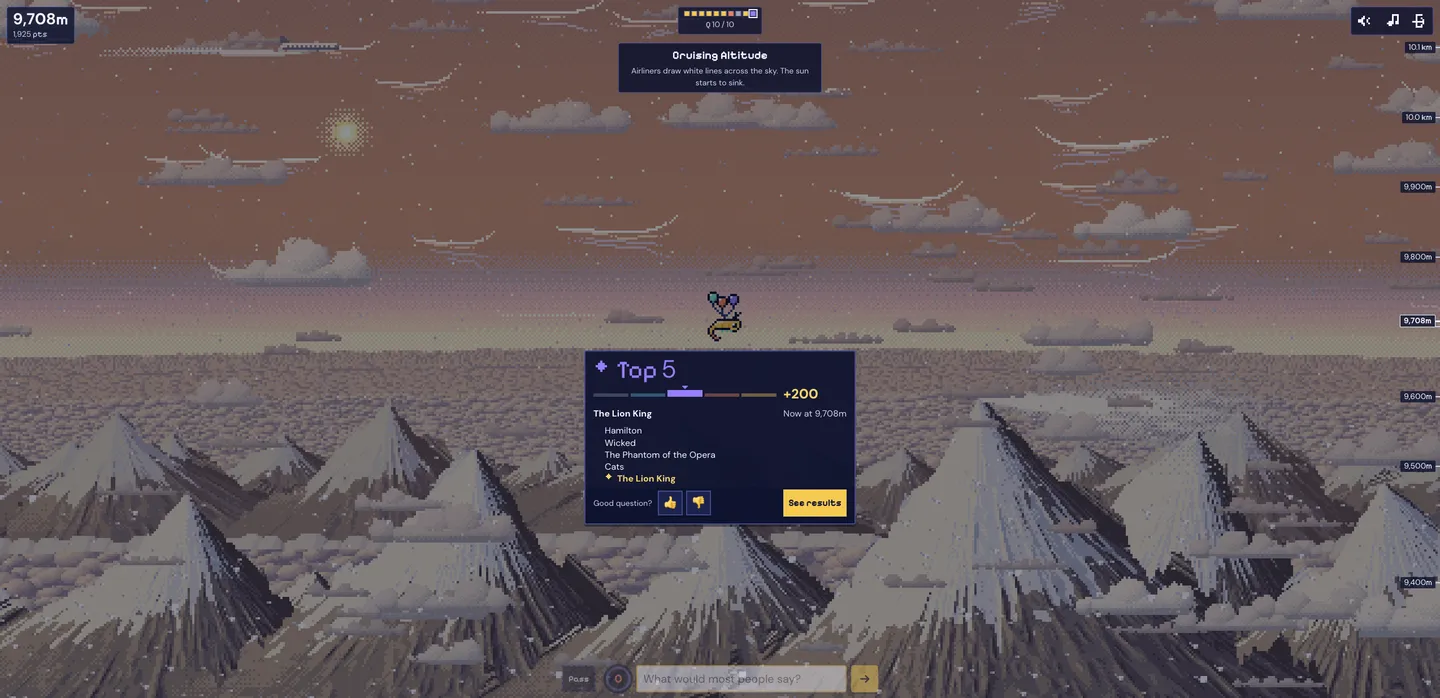
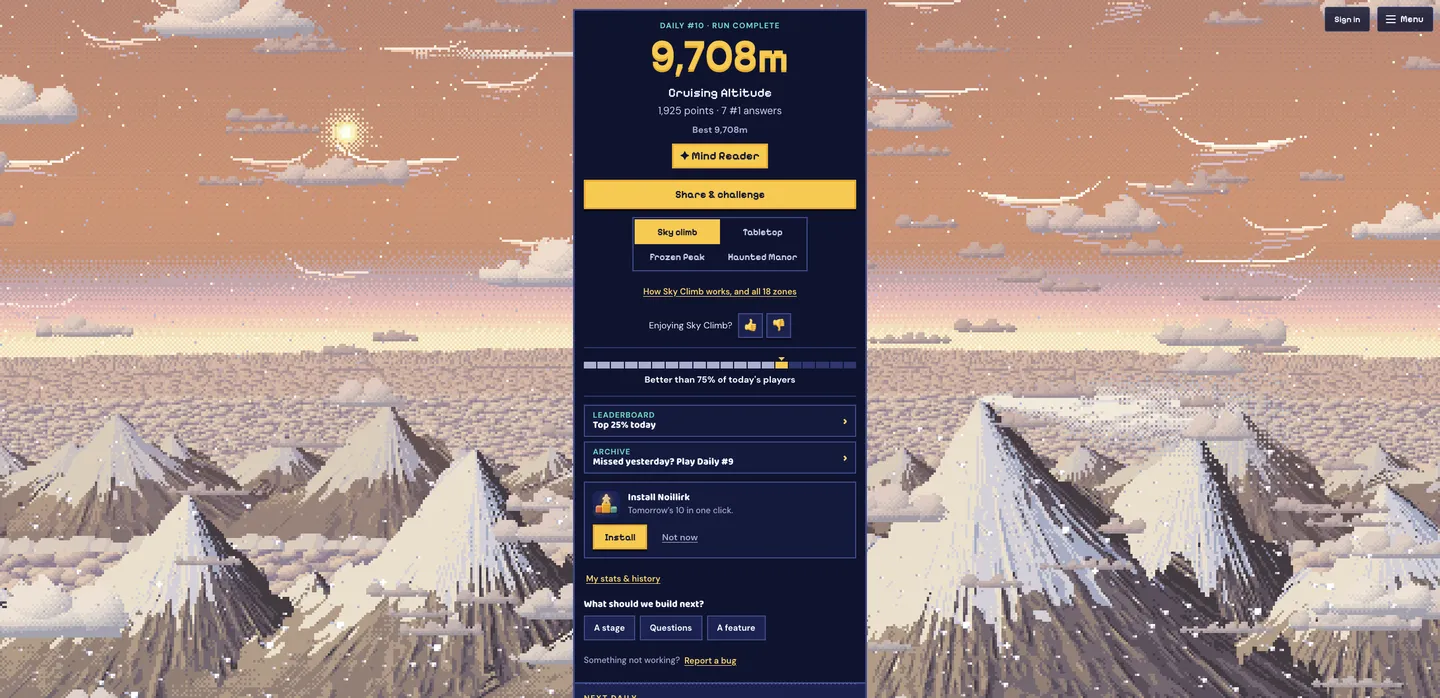
The Three Presses That Make Up a Noillirk Answer
- 1
Type the obvious answer
The prompt names a category and the box takes free text. The first answer that comes to mind is usually the one the board puts first, so the fast keystrokes and the high-scoring ones are the same. Thirty seconds is generous for one word and tight for a sentence. (Keyboard)
- 2
Submit with Enter
Enter, or the arrow beside the box, sends whatever is typed. There is no confirmation step, so a half-finished word goes in as written and is scored as written. (Enter)
- 3
Tap the reveal away
The result card animates in and the page can be tapped to speed it up. Across ten prompts that is the cheapest second in the run to cut, and it is cut without touching the score. (Tap)
- 4
Pass only when the category is blank
Pass moves on with no answer and no points. An accepted guess always pays something, from 10 points on the off-the-board band upwards, so a pass is worth less than almost any answer you can produce in time. (Pass)
The 2,500-Point Ladder: Bands, Multipliers and Fourteen Kilometres
Each accepted answer lands in one of five bands, taken from where it sits on the prompt's board of a hundred people: 10 points off the board, 25 in the top ten, 50 in the top five, 75 as runner-up, 100 for the number one answer. The multiplier climbs with the question number. Prompts three to five count twice, six to eight three times, and nine and ten four times.
Ten number-one answers across the ladder add up to exactly 2,500: 200 from the two single-weight prompts, 600 from the three doubled ones, 900 from the tripled stretch and 800 from the last pair. The site publishes every rung of that ladder but never the sum, and the sum is what makes the ceiling feel like a target rather than a rumour. Nine first answers and one top-five finish is 2,450, so a personal best can sit fifty points under perfect and look almost identical on the summary.
Every 25 points pulls one of the table's hundred people onto your tile, which is why the score and the crowd are the same fact counted twice: 2,500 points is all hundred, and nothing above that exists.
Why the Last Three Prompts Decide a Fast Climb
The published markers do not scale evenly. A number-one answer on the opening prompt is 100 points and lifts the climber to 30 m, while a perfect Daily of 2,500 points ends at 14.0 km. If the two figures were proportional, 100 points would be about 560 m. They are not, so most of the altitude has to arrive later in the run rather than at the start, and the multiplier ladder says where.
For a route, that changes where attention is worth spending. The first two prompts are warm-ups: thirty seconds each, a few dozen metres of climb. The last two carry 800 of the 2,500 points and four times the weight of the opening pair. A player who treats all ten prompts as equally important is spending the cheapest minutes on the cheapest part of the climb, and the same habit will cost a streak on the day a category lands badly.
The altitude ladder in the interface agrees with that reading. It marks the climb in 25 m steps, so the last prompts visibly move several rungs at once while the first ones barely shift the marker.
Noillirk Tips: Why the Dull Answer Is the Fast One
The board is an estimate of how a hundred people would answer, prepared in advance and marked as an estimate in the game. It is not a live tally of today's players. That distinction is the whole speed argument: there is no trend to wait for, because the trend was fixed before the prompt went live, so the first ordinary answer in your head is the one to type.
Cleverness costs you on both objectives. Asked for a European capital, Skopje is correct, scores 10 points on the off-the-board band and moves the climber a handful of metres; Paris scores ten times as much and brings the crowd with it. The same rule makes the run quicker, because the obvious answer is also the fastest one to produce and the fastest one to type.
The title on the end screen is a compact diagnosis. Mind Reader needs three or more first answers, so it tells you at a glance whether the run was built on reading the crowd or on knowing things, and a run that ends on Free Thinker is a run that spent its minutes being interesting instead of fast.
Noillirk FAQ
How long does a Noillirk Daily take?
Ten prompts at up to thirty seconds each is five minutes of answering at most, plus a few seconds of reveal after every guess. Tapping the reveal shortens that second part.
What is the maximum score in Noillirk?
2,500 points, which is ten number-one answers through the multiplier ladder. The game maps that total to 14.0 km on the sky climb and to all hundred people on the table.
Can you skip a prompt in Noillirk?
Yes, with Pass. It moves to the next prompt without an answer, and it scores nothing, so it costs more than a weak guess that is at least accepted.
Is the Noillirk board a live count of players?
No. Each prompt's board is an estimate of how a hundred people would answer, marked as an estimate in the result card. Only the top five are shown, even after the run.
What do the metres in Noillirk mean?
They are the sky-climb framing of your score. Points lift the figurine on balloons through named zones, and the same run can be shown on the table instead, where points pull people onto your tile.
Is there a Noillirk mode without the daily limit?
Yes. Unlimited runs the same prompts with no daily cap, in sets of ten, twenty or endless, and it is free like the Daily.
Games Like Noillirk for a Five-Minute Session
Other browser games on this site that fit the same five-minute slot, without the daily reset.


