
2 min drill

2 min drill
2 Min Drill: How Many Calls a Drive Actually Takes
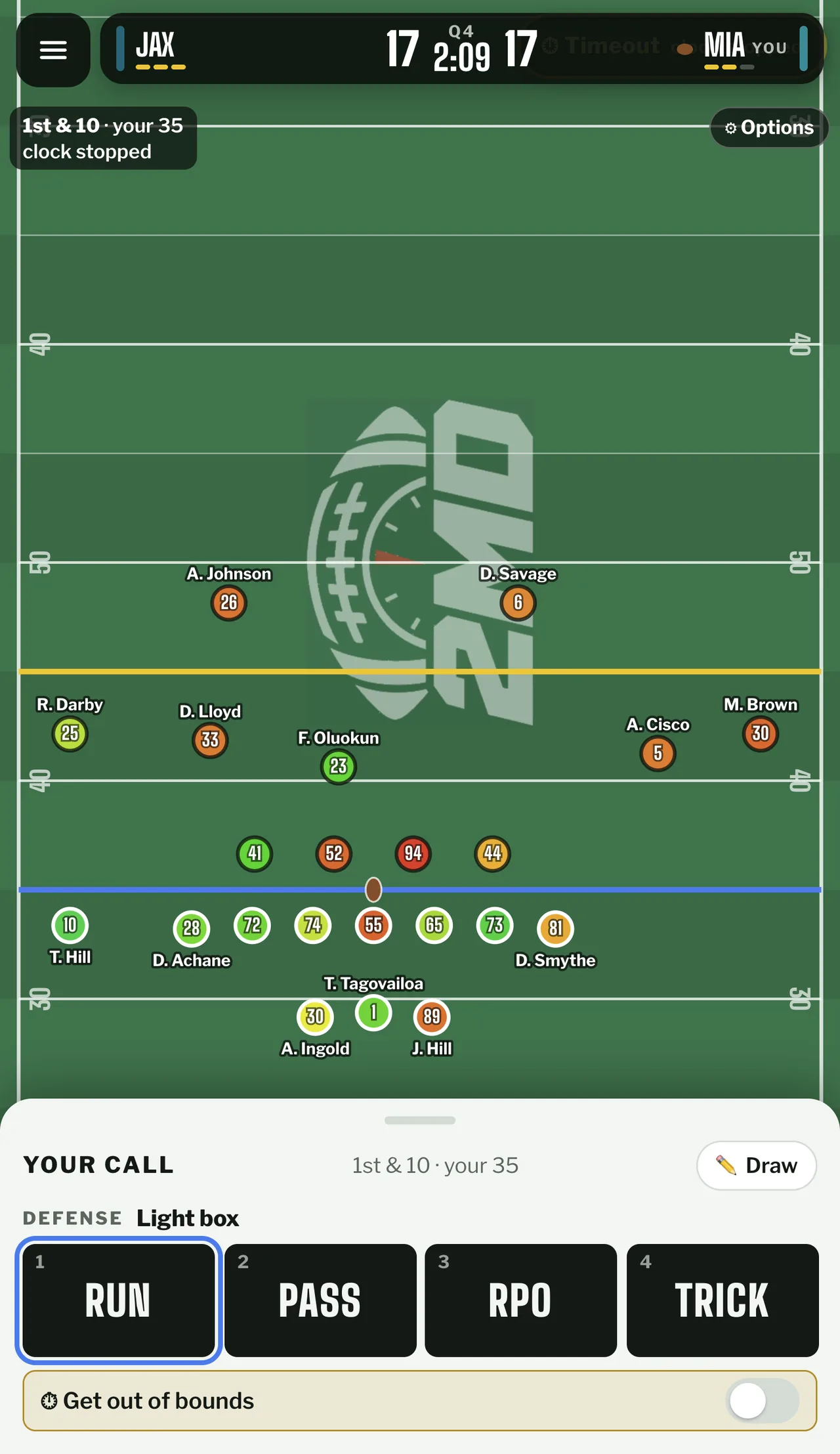
A drive in 2 min drill is a short chain of decisions, and the game prices every one of them. You are given a down, a distance, a field position, a defensive look and four buttons: run, pass, RPO and trick. Each call returns a result card with two numbers, the outcome on the field and the shift in win chance. The run ends when the clock does, not when you run out of ideas.
That is a route problem in thin disguise. The shortest way to the end of a drive is not the fewest taps, it is the sequence of calls that keeps win chance rising while the clock falls. The game keeps a running verdict on whether you managed that, and it is blunt about it: one result card can read as good as any while a later one calls the same kind of decision a big miss.
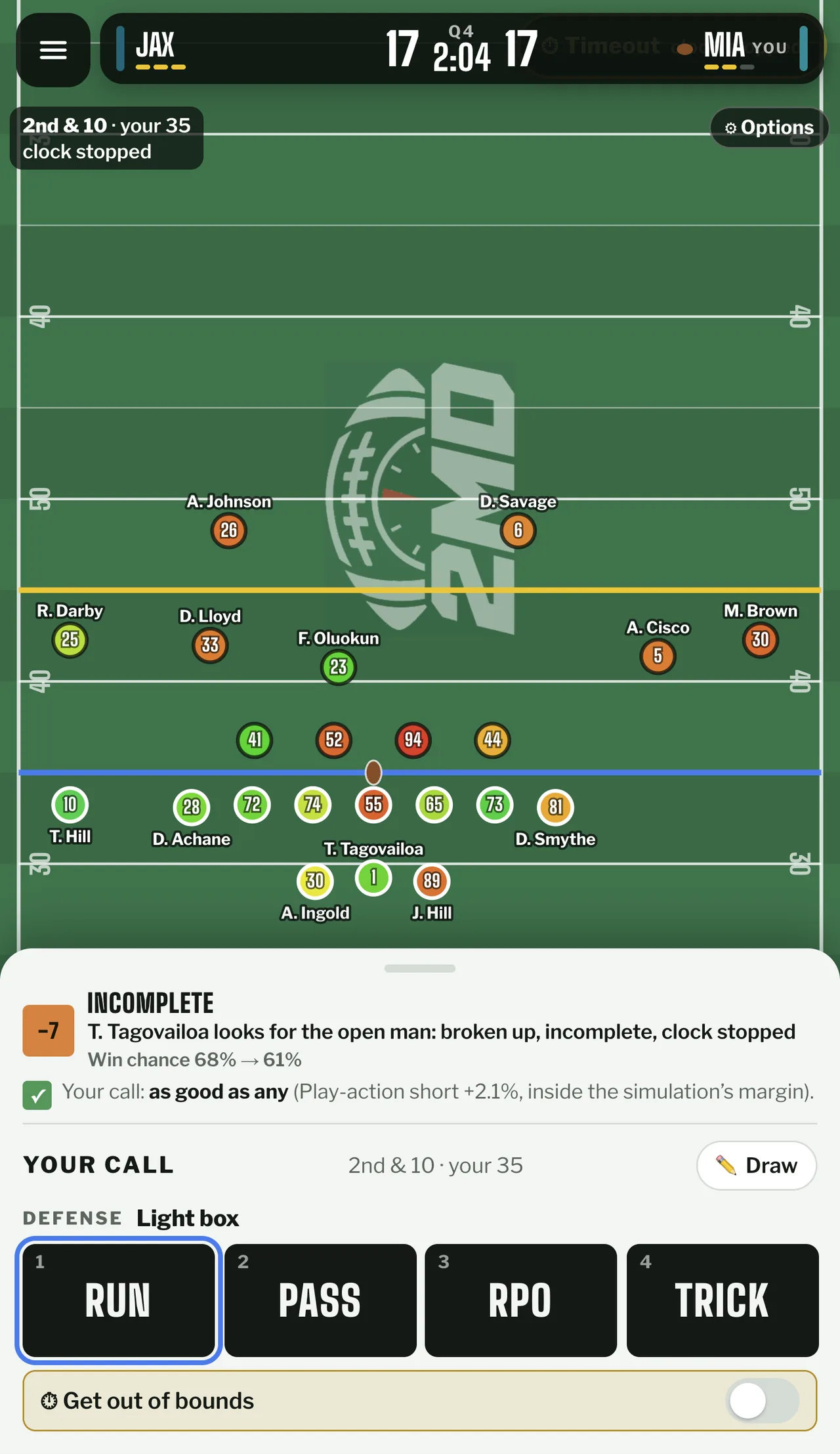
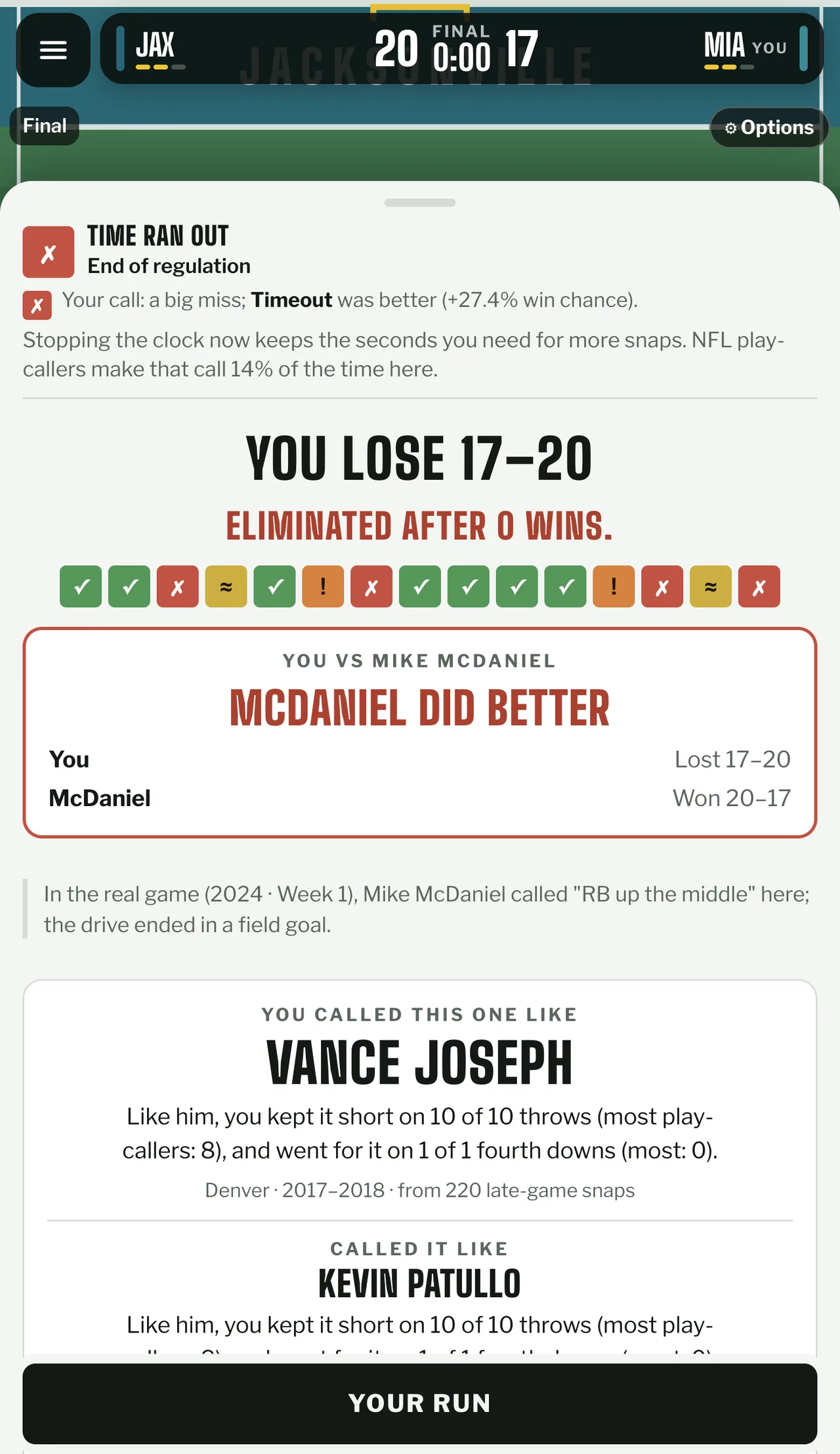
2 Min Drill in Three Frames: 17-17, the Breakup, 17-20
How a Snap Is Called in 2 Min Drill: Three Inputs and a Toggle
- 1
Call a play
Click or tap one of the four calls on the sheet, or pick with the number keys from 1 to 9 without moving the cursor. The four on screen are numbered 1 to 4, so the top of the sheet is always one press away. (1 to 9)
- 2
Skip the kickoff
The space bar cuts the kickoff animation. It is the only stretch of the game that is pure waiting, and skipping it is the difference between a run that drags and one that keeps its rhythm. (Space)
- 3
Ask for the sideline
The switch under the call sheet asks the receiver to get out of bounds, which stops the clock after the catch. It reads like a setting and behaves like a route decision, because it trades yards for seconds. (Toggle)
Win Chance per Snap: Pricing a Drive Call by Call
Every result card carries a win-chance figure before and after the call. A pass broken up on second and ten took the run from 68% to 61%, and the card still marked the decision as as good as any, because the better alternative was 2.1 points higher and inside the simulation's margin. Later, on the last snap of regulation, the verdict turned flat: a big miss, with timeout worth 27.4 points of win chance more than the call that was made.
Those two lines are the most useful thing the game prints, and they say different things. The first says a call can be right and still lose yardage. The second says a call can be defensible on its own terms and still be the wrong call for the situation, because the clock was the scarce resource and the play treated it as free. A route built on the first reading alone will look competent and lose.
Read together, the cards describe expected value rather than outcome, which is why the final score is a poor guide to whether the drive was called well. Losing 17-20 after a sound sequence and losing 17-20 after three gambles produce the same summary screen and opposite lessons.
One Loss Ends Survivor: The Shortest Run in the Game
The game ships four ways to play the same problem: Daily, Survivor, Versus and Pro. Daily is today's drive, one scenario put in front of everyone who opens the page that day. Survivor is the shortest of the four, because a single loss ends the run rather than the drive, so a bad ending is not a bad series of calls but a finished session.
The Survivor run I looked at lasted one game. It ended 17-20 in regulation, the summary read eliminated after no wins, and the whole thing took two minutes and nine seconds of game clock. That makes Survivor the cheapest place to test a route. A Daily asks whether you can finish a drive; Survivor asks whether the route survives contact with a real clock and answers in one game rather than several.
There is a cost to that speed, and it is worth stating plainly. One game is a small sample, so a single Survivor loss says more about the situation than about your calling. Two or three runs on the same kind of endgame tell you whether the habit is the problem.
2 Min Drill Tips: A Good Call Can Still Be the Wrong One
Two habits separate a route that holds from one that merely looks sensible. The first is to read the defense before touching the buttons. The sheet names the look on every snap, and a light box is an invitation that a crowded one is not. The second is to price the clock on every down rather than on the last one alone: stopping it keeps snaps available, and those snaps are the only thing that can still change the result.
The last snap of that run is the clean example. Stopping the clock was worth 27.4 points of win chance, and the call that was made did not take it. The card added that NFL play-callers make that call 14% of the time in that spot, which is a useful correction to the instinct that the obvious call is the common one. It usually is not, at the end of a game.
The end screen offers a second opinion that is easy to skip past. It compares your calls with the coach who called the real game the situation came from, and with play-callers whose late-game tendencies match yours. The coach comparison is the one to read, because it is the same drive: McDaniel called a run up the middle and the drive ended in a field goal, while this run ended on a timeout that was never taken.
2 Min Drill FAQ
How do you play 2 min drill?
You are handed a late-game situation and four calls to choose from. Pick one with a click, a tap or a number key, and the game returns the result plus the change in win chance before the next snap.
What are the modes in 2 min drill?
Daily, Survivor, Versus and Pro. Daily gives you the day's shared drive, Survivor ends the run at the first loss, and the game lists all four together when it opens.
What does win chance mean in 2 min drill?
It is the simulation's estimate of your odds of winning from that situation, recalculated after every call. The result card also reports whether the alternative was better and by how much, with a margin for calls that are close.
Why did 2 min drill call my play a big miss?
Because a different call was worth substantially more win chance. In the run shown here, taking the timeout on the final snap was worth 27.4 points more than the play that was called.
Can you skip the kickoff animation?
Yes. The space bar cuts it, and since it is the only part of a run that asks nothing of you, skipping it is free time back on the clock.
Does 2 min drill work with touch controls?
Yes. The call sheet responds to a click or a tap, so the number keys are a shortcut rather than a requirement.
Games Like 2 Min Drill for a Short Session
Other browser games on this site that reward a repeatable short run rather than a long one.


